
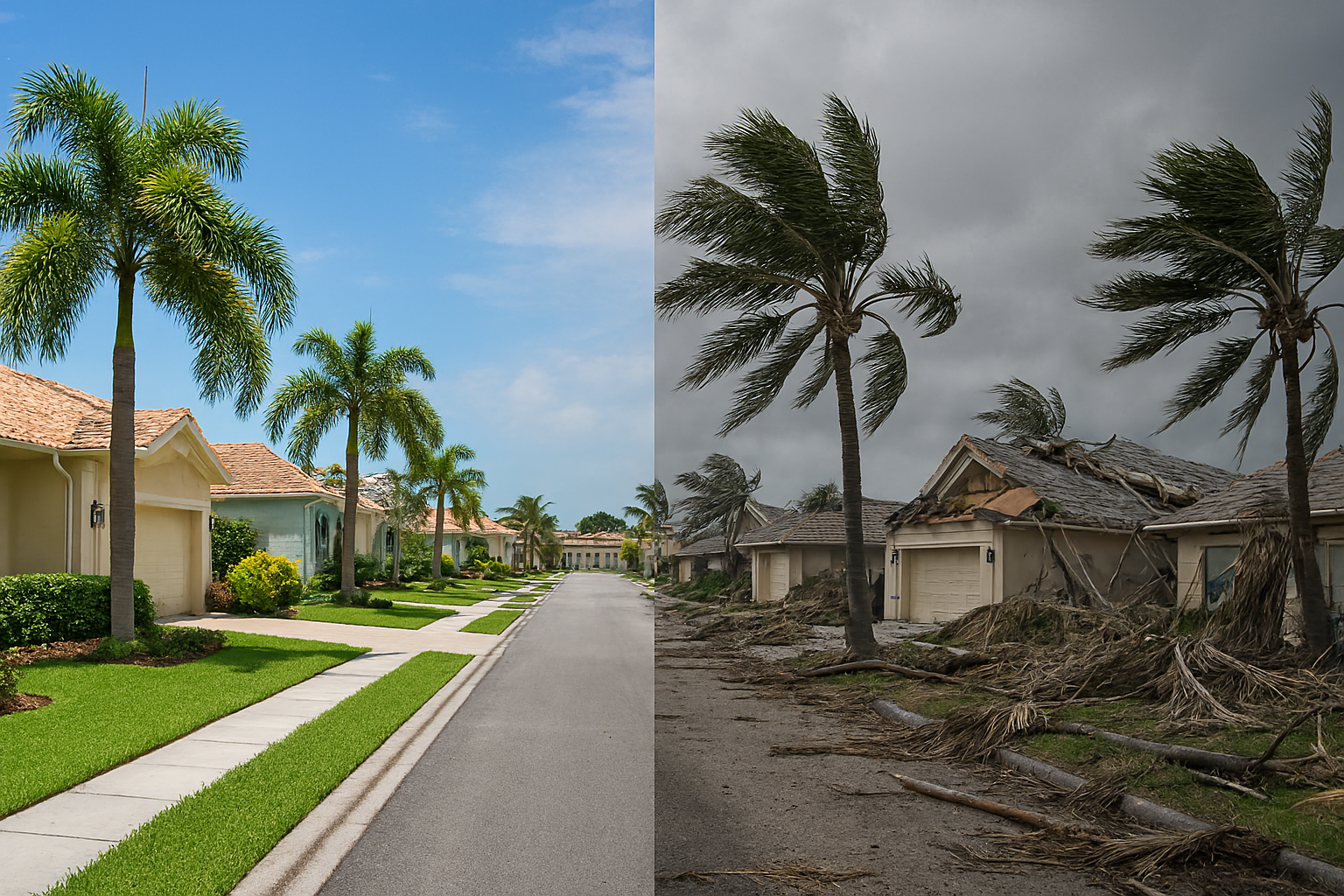
For many Tampa Bay homeowners, the 2025 hurricane season felt strangely contradictory. On one hand, the region escaped direct hits from the long list of named storms that churned through the Atlantic. On the other, every near‑miss served as a reminder of just how unpredictable these systems truly are. Tampa Bay didn’t avoid danger because the storms were weak or harmless, we avoided danger because of timing, temperature shifts, and tiny atmospheric changes that nudged powerful storms just a little to the east or west.
And that’s the part too many people overlook.
In Florida, especially along the Gulf Coast, “near‑normal” or “quiet for us” never means safe. The 2025 season proved that again and again. It was a year defined by luck not protection. And as we move into 2026, the lesson is clear: the risk is always there, even when the storms don’t make landfall.
A Season of Storms That Just Barely Missed Us
The Atlantic basin saw a long list of named storms in 2025, many of them strong, fast‑developing, and unpredictable. Tampa Bay watched storm after storm form, intensify, wobble, and then curve away at the last minute. Some tracked north into the Big Bend. Others veered east into the Atlantic. A few weakened unexpectedly before reaching the Gulf.
But meteorologists were quick to point out something important:
Most of those storms were only one small shift away from a completely different outcome.
A slight change in sea‑surface temperature.
A pocket of dry air.
A shift in upper‑level winds.
A ridge of high pressure that built or collapsed at just the right moment.
These tiny variables often measured in miles or minutes are what kept Tampa Bay out of the direct path. When you zoom out, it becomes clear that the region wasn’t “spared” because it’s protected or lucky. We were simply on the right side of the wrong storms.
And that’s not a strategy anyone should rely on.
Why Hurricane Trajectories Are So Sensitive to Small Changes
Hurricanes are massive systems, but their paths are surprisingly sensitive. A storm hundreds of miles wide can change direction because of something as subtle as a shift in steering currents thousands of feet above the surface. When meteorologists talk about “wobbles,” they’re not exaggerating; these storms can drift left or right by dozens of miles in a matter of hours.
For Tampa Bay, that sensitivity is especially important.
Our region sits in a geographic pocket where storms approaching from the south or southwest can easily curve toward us if the atmospheric setup changes even slightly. A storm that looks like it’s heading toward the Panhandle can suddenly angle northeast. A system expected to stay offshore can drift closer as pressure patterns shift.
In 2025, several storms did exactly that: they wobbled, they drifted, they changed speed but ultimately missed us. If even one of those storms had shifted 20–40 miles west or east at the wrong moment, Tampa Bay would have been dealing with a very different season.
This is why meteorologists emphasize preparation, not prediction.
Forecasts are improving every year, but the atmosphere still has the final say.
Near‑Misses Don’t Reduce Risk, They Highlight It
There’s a dangerous mindset that creeps in after a season like 2025:
“We got lucky last year, so maybe we’ll get lucky again.”
But near‑misses don’t mean the region is protected. They mean the region was exposed and the outcome just happened to fall in our favor.
Every storm that curved away was a reminder of how vulnerable Tampa Bay truly is:
- We have one of the most storm‑prone coastlines in the country.
- Our population continues to grow, increasing the number of homes at risk.
- Our aging housing stock includes thousands of homes built before modern wind standards.
When you combine these factors with the unpredictability of storm tracks, the message becomes clear:
Preparation isn’t optional, it’s essential.
Why Tampa Bay Homeowners Can’t Rely on Luck in 2026
As we move into the new season, meteorologists are already warning that the Gulf remains warm, the atmosphere remains active, and the patterns that shaped 2025 could easily repeat or intensify.
That means:
- More fast‑forming storms
- More rapid intensification
- More unpredictable tracks
- More last‑minute shifts
And for Tampa Bay, a region that has historically seen long stretches without direct hits followed by devastating impacts, the stakes are high.
The question isn’t if a storm will eventually take the “wrong” wobble; it’s when.
Preparation Is the Only Reliable Strategy
If 2025 taught us anything, it’s that homeowners can’t wait for a storm to appear in the cone before taking action. By the time a storm is three days out, installation schedules are full, materials are limited, and the window for meaningful protection is already closing.
Preparation needs to happen early, long before the first named storm forms.
For Tampa Bay homeowners, that means:
- Understanding your home’s vulnerabilities
- Upgrading to impact‑rated protection before the season peaks
- Having a plan for evacuation, supplies, and communication
- Staying informed about changing weather patterns
Storm Shielder has seen firsthand how last‑minute decisions can leave homeowners scrambling. When a storm shifts unexpectedly and they often do, there’s no time to install new protection or reinforce weak points. The only homes that stay safe are the ones that were prepared before the forecast changed.
The 2025 Season Was a Warning, Not a Relief
It’s tempting to look back at a season of near‑misses and feel reassured. But for Tampa Bay, 2025 should be viewed as a wake‑up call. We saw how many storms came close. We saw how easily their paths could have shifted. We saw how unpredictable the atmosphere can be.
And we saw how thin the line is between “we dodged it” and “we’re in the cone.”
The storms didn’t miss us because the risk was low, they missed us because the atmosphere made a series of tiny decisions in our favor. That’s not something any homeowner should count on.
Final Thoughts: The Risk Is Always There, But So Is the Opportunity to Prepare
Tampa Bay is a beautiful place to live, but it comes with a responsibility: protecting your home from storms that don’t always give warning, don’t always follow the models, and don’t always stay offshore.
The 2025 season proved that uncertainty is the rule, not the exception.
The storms will keep coming.
Their paths will keep shifting.
And the risk will always be part of life on the Gulf.
But preparation – real, proactive, early preparation – gives homeowners control in a situation where so much is unpredictable.
Storm Shielder is here to help Tampa Bay homeowners take that control, strengthen their homes, and stay ready for whatever the 2026 season brings.